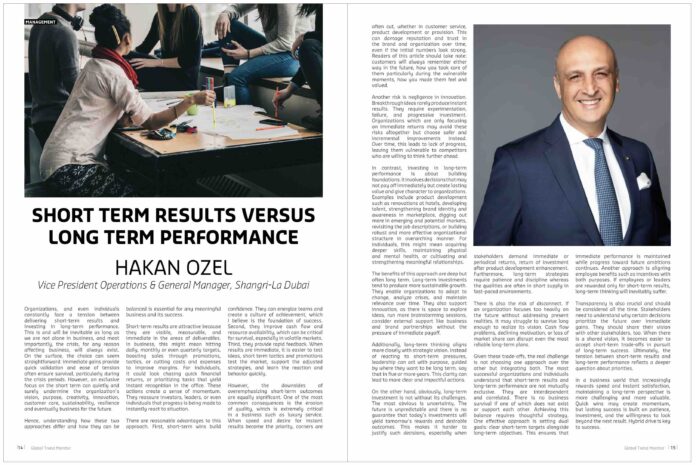

Hakan Ozel Vice President Operations & General Manager, Shangri-La Dubai
Organizations, and even individuals constantly face a tension between delivering short-term results and investing in long-term performance. This is and will be inevitable as long as we are not alone in business, and most importantly, the crisis, for any reason affecting business, will always exist. On the surface, the choice can seem straightforward: immediate gains provide quick validation and ease of tension often ensure survival, particularly during the crisis periods. However, an exclusive focus on the short term can quietly and surely undermine the organization’s vision, purpose, creativity, innovation, customer care, sustainability, resilience and eventually business for the future. Hence, understanding how these two approaches differ and how they can be balanced is essential for any meaningful business and its success.
Short-term results are attractive because they are visible, measurable, and immediate in the areas of deliverables. In business, this might mean hitting daily, monthly or even quarterly targets, boosting sales through promotions, tactics, or cutting costs and expenses to improve margins. For individuals, it could look chasing quick financial returns, or prioritizing tasks that yield instant recognition in the office. These actions create a sense of momentum. They reassure investors, leaders, or even individuals that progress is being made to instantly react to situation.
There are reasonable advantages to this approach. First, short-term wins build confidence. They can energize teams and create a culture of achievement, which I believe is the foundation of success. Second, they improve cash flow and resource availability, which can be critical for survival, especially in volatile markets. Third, they provide rapid feedback. When results are immediate, it is easier to test ideas, short term tactics and promotions test the market, support the adjusted strategies, and learn the reaction and behavior quickly.
However, the downsides of overemphasizing short-term outcomes are equally significant. One of the most common consequences is the erosion of quality, which is extremely critical in a business such as luxury service. When speed and desire for instant results become the priority, corners are often cut, whether in customer service, product development or provision. This can damage reputation and trust in the brand and organization over time, even if the initial numbers look strong. Readers of this article should take note: customers will always remember either way in the future, how you took care of them particularly during the vulnerable moments, how you made them feel and valued.
Another risk is negligence in innovation. Breakthrough ideas rarely produce instant results. They require experimentation, failure, and progressive investment. Organizations which are only focusing on immediate returns may avoid these risks altogether but choose safer and incremental improvements instead. Over time, this leads to lack of progress, leaving them vulnerable to competitors who are willing to think further ahead.
In contrast, investing in long-term performance is about building foundations. It involves decisions that may not pay off immediately but create lasting value and give character to organizations. Examples include product development such as renovations at hotels, developing talent, strengthening brand identity and awareness in marketplace, digging out more in emerging and potential markets, revisiting the job descriptions, or building robust and more effective organizational structure in overarching manner. For individuals, this might mean acquiring deeper skills, maintaining physical and mental health, or cultivating and strengthening meaningful relationships.
The benefits of this approach are deep but often long term. Long-term investments tend to produce more sustainable growth. They enable organizations to adapt to change, analyze crises, and maintain relevance over time. They also support innovation, as there is space to explore ideas, run more brainstorming sessions, consider external support like business and brand partnerships without the pressure of immediate payoff.
Additionally, long-term thinking aligns more closely with strategic vision. Instead of reacting to short-term pressures, leadership can act with purpose, guided by where they want to be long term, say that in five or more years. This clarity can lead to more clear and impactful actions.
On the other hand, obviously, long-term investment is not without its challenges. The most obvious is uncertainty. The future is unpredictable and there is no guarantee that today’s investments will yield tomorrow’s rewards and desirable outcomes. This makes it harder to justify such decisions, especially when stakeholders demand immediate or periodical returns, return of investment after product development enhancement. Furthermore, long-term strategies require patience and discipline whereas the qualities are often in short supply in fast-paced environments.
There is also the risk of disconnect. If an organization focuses too heavily on the future without addressing present realities, it may struggle to survive long enough to realize its vision. Cash flow problems, declining motivation, or loss of market share can disrupt even the most reliable long-term plans.
Given these trade-offs, the real challenge is not choosing one approach over the other but integrating both. The most successful organizations and individuals understand that short-term results and long-term performance are not mutually exclusive. They are interdependent and correlated. There is no business survival if one of which does not exist or support each other. Achieving this balance requires thoughtful strategy. One effective approach is setting dual goals: clear short-term targets alongside long-term objectives. This ensures that immediate performance is maintained while progress toward future ambitions continues. Another approach is aligning employee benefits such as incentives with both purposes. If employees or leaders are rewarded only for short-term results, long-term thinking will inevitably suffer.
Transparency is also crucial and should be considered all the time. Stakeholders need to understand why certain decisions prioritize the future over immediate gains. They should share their vision with other stakeholders, too. When there is a shared vision, it becomes easier to accept short-term trade-offs in pursuit of long-term success. Ultimately, the tension between short-term results and long-term performance reflects a deeper question about priorities.
In a business world that increasingly rewards speed and instant satisfaction, maintaining a long-term perspective is more challenging and more valuable. Quick wins may create momentum, but lasting success is built on patience, investment, and the willingness to look beyond the next result. Hybrid drive is key to success.

