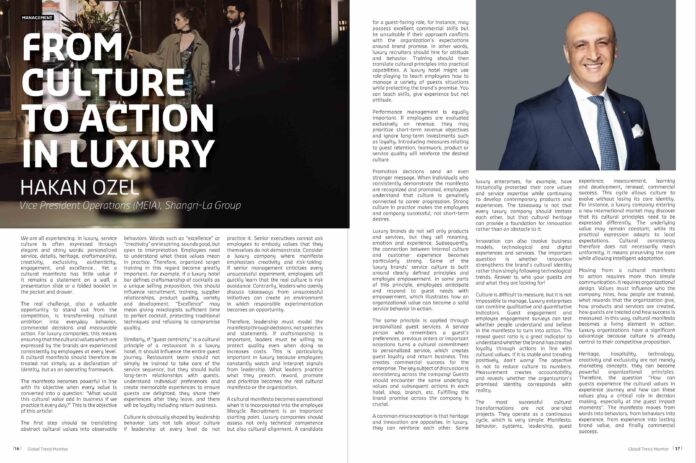

Hakan Ozel, Vice President Operations (MEIA), Shangri-La Group
We are all experiencing: In luxury, service culture is often expressed through elegant and shiny words: personalized service, details, heritage, craftsmanship, creativity, exclusivity, authenticity, engagement, and excellence… Yet a cultural manifesto has little value if it remains a statement on a wall, a presentation slide or a folded booklet in the pocket and drawer. The real challenge, also a valuable opportunity to stand out from the competition, is transforming cultural ambition into everyday behavior, commercial decisions and measurable action. For luxury companies, this means ensuring that the cultural values which are expressed by the brands are experienced consistently by employees at every level. A cultural manifesto should therefore be treated not simply as a declaration of identity, but as an operating framework.
The manifesto becomes powerful in line with its objective when every value is converted into a question: “What would this cultural value add in business if we practice it every day?” This is the objective of this article!
The first step should be translating abstract cultural values into observable behaviors. Words such as “excellence” or “creativity” are inspiring, sounds good, but open to interpretation. Employees need to understand what these values mean in practice. Therefore, organized target training in this regard become greatly important. For example, if a luxury hotel bar defines craftsmanship of cocktails as a unique selling preposition, this should influence recruitment, training, supplier relationships, product quality, variety and development. “Excellence” may mean giving mixologists sufficient time to perfect cocktail, protecting traditional techniques and refusing to compromise quality.
Similarly, if “guest centricity” is a cultural principle of a restaurant in a luxury hotel, it should influence the entire guest journey. Restaurant team should not simply be trained to take care of the service sequence, but they should build long-term relationships with guests, understand individual preferences and create memorable experiences to ensure guests are delighted, they share their experiences after they leave, and there will be loyalty including return business.
Culture is obviously shaped by leadership behavior. Lets not talk about culture if leadership at every level do not practice it. Senior executives cannot ask employees to embody values that they themselves do not demonstrate. Consider a luxury company where manifesto emphasizes creativity and risk-taking. If senior management criticizes every unsuccessful experiment, employees will quickly learn that the real culture is risk avoidance. Contrarily, leaders who openly discuss takeaways from unsuccessful initiatives can create an environment in which responsible experimentation becomes an opportunity. Therefore, leadership must model the manifesto through decisions, not speeches and statements. If craftsmanship is important, leaders must be willing to protect quality even when doing so increases costs. This is particularly important in luxury because employees constantly watch and interpret signals from leadership. What leaders practice what they preach, reward, promote and prioritize becomes the real cultural manifesto or the organization.
A cultural manifesto becomes operational when it is incorporated into the employee lifecycle. Recruitment is an important starting point. Luxury companies should assess not only technical competence but also cultural alignment. A candidate for a guest-facing role, for instance, may possess excellent commercial skills but be unsuitable if their approach conflicts with the organization’s expectations around brand promise. In other words, luxury recruiters should hire for attitude and behavior. Training should then translate cultural principles into practical capabilities. A luxury hotel might use role-playing to teach employees how to manage a variety of guests situations while protecting the brand’s promise. You can teach skills, give experience but not attitude.
Performance management is equally important. If employees are evaluated exclusively on revenue, they may prioritize short-term revenue objectives and ignore long-term investments such as loyalty. Introducing measures relating to guest retention, teamwork, product or service quality will reinforce the desired culture.
Promotion decisions send an even stronger message. When individuals who consistently demonstrate the manifesto are recognized and promoted, employees understand that culture is genuinely connected to career progression. Strong culture in practice makes the employees and company successful, not short-term desires.
Luxury brands do not sell only products and services, but they sell meaning, emotion and experience. Subsequently, the connection between internal culture and customer experience becomes particularly strong. Some of the luxury brands’ service culture is built around clearly defined principles and employee empowerment. In some parts of this principle, employees anticipate and respond to guest needs with empowerment, which illustrates how an organizational value can become a solid service behavior in action.
The same principle is applied through personalized guest services. A service person who remembers a guest’s preferences, previous orders or important occasions turns a cultural commitment to personalized service, which creates guest loyalty and return business. This creates commercial success for the enterprise. The key subject of discussion is consistency across the company! Guests should encounter the same underlying values and subsequent actions in each hotel, shop, branch, etc. Fulfilling the brand promise across the company is crucial.
A common misconception is that heritage and innovation are opposites. In luxury, they can reinforce each other. Some luxury enterprises, for example, have historically protected their core values and service expertise while continuing to develop contemporary products and experiences. The takeaway is not that every luxury company should imitate each other, but that cultural heritage can provide a foundation for innovation rather than an obstacle to it.
Innovation can also involve business models, technological and digital experiences and services. The important question is whether innovation strengthens the brand’s cultural identity rather than simply following technological trends. Answer is, who your guests are and what they are looking for!
Culture is difficult to measure, but it is not impossible to manage. Luxury enterprises can combine qualitative and quantitative indicators. Guest engagement and employee engagement surveys can test whether people understand and believe in the manifesto to turn into action. The repeat guest ratio is a great indicator to understand whether the brand has created loyalty through actions in line with cultural values. If it is stable and trending positively, don’t worry! The objective is not to reduce culture to numbers. Measurement creates accountability and reveals whether the organization’s promised identity corresponds with reality.
The most successful cultural transformations are not one-shot projects. They operate as a continuous cycle, which is very simple: Manifesto, behavior, systems, leadership, guest experience, measurement, learning and development, renewal, commercial success. This cycle allows culture to evolve without losing its core identity. For instance, a luxury company entering a new international market may discover that its cultural principles need to be expressed differently. The underlying value may remain constant, while its practical expression adapts to local expectations. Cultural consistency therefore does not necessarily mean uniformity; it means preserving the core while allowing intelligent adaptation.
Moving from a cultural manifesto to action requires more than simple communication. It requires organizational design. Values must influence who the company hires, how people are trained, what rewards that the organization give, how products and services are created, how guests are treated and how success is measured. In this way, cultural manifesto becomes a living element in action. Luxury organizations have a significant advantage because culture is already central to their competitive proposition. Heritage, hospitality, technology, creativity and exclusivity are not merely marketing concepts. they can become powerful organizational principles. Therefore, the question “How can guests experience the cultural values in experience journey and how can these values play a critical role in decision making, especially at the guest impact moments”. The manifesto moves from words into behaviors, from behaviors into experience, from experience into lasting brand value, and finally commercial success.

