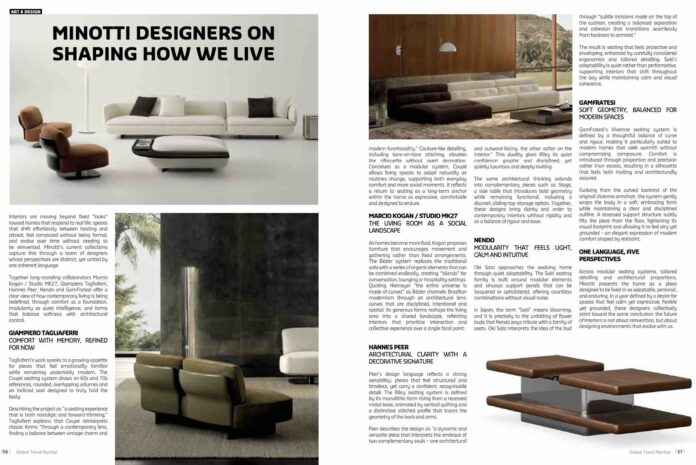

Interiors are moving beyond fixed “looks” toward homes that respond to real life: spaces that shift effortlessly between hosting and retreat, feel composed without being formal, and evolve over time without needing to be reinvented. Minotti’s current collections capture this through a team of designers whose perspectives are distinct, yet united by one coherent language. Together long-standing collaborators Marcio Kogan / Studio MK27, Giampiero Tagliaferri, Hannes Peer, Nendo and GamFratesi offer a clear view of how contemporary living is being redefined, through comfort as a foundation, modularity as quiet intelligence, and forms that balance softness with architectural control.
Giampiero Tagliaferri: Comfort with memory, refined for now
Tagliaferri’s work speaks to a growing appetite for pieces that feel emotionally familiar while remaining undeniably modern. The Coupé seating system draws on 60s and 70s references, rounded, overlapping volumes and an inclined seat designed to truly hold the body. Describing the project as “a seating experience that is both nostalgic and forward-thinking,” Tagliaferri explains that Coupé reinterprets classic forms “through a contemporary lens, finding a balance between vintage charm and modern functionality.” Couture-like detailing, including tone-on-tone stitching, elevates the silhouette without overt decoration. Conceived as a modular system, Coupé allows living spaces to adapt naturally as routines change, supporting both everyday comfort and more social moments. It reflects a return to seating as a long-term anchor within the home as expressive, comfortable and designed to endure.
Marcio Kogan / Studio MK27: The living room as a social landscape
As homes become more fluid, Kogan proposes furniture that encourages movement and gathering rather than fixed arrangements. The Bézier system replaces the traditional sofa with a series of organic elements that can be combined endlessly, creating “islands” for conversation, lounging or hospitality settings. Quoting Niemeyer “the entire universe is made of curves” as Bézier channels Brazilian modernism through an architectural lens: curves that are disciplined, intentional and spatial. Its generous forms reshape the living area into a shared landscape, reflecting interiors that prioritise interaction and collective experience over a single focal point.
Hannes Peer: Architectural clarity with a decorative signature
Peer’s design language reflects a strong sensibility: pieces that feel structured and timeless, yet carry a confident, recognisable detail. The Riley seating system is defined by its monolithic form rising from a recessed metal base, animated by vertical quilting and a distinctive stitched profile that traces the geometry of the back and arms. Peer describes the design as “a dynamic and versatile piece that interprets the embrace of two complementary souls – one architectural and outward-facing, the other softer on the interior.” This duality gives Riley its quiet confidence: graphic and disciplined, yet quietly luxurious and deeply inviting. The same architectural thinking extends into complementary pieces such as Stage, a side table that introduces bold geometry while remaining functional, including a discreet sliding-top storage option. Together, these designs bring clarity and order to contemporary interiors without rigidity and as a balance of rigour and ease.
Nendo: Modularity that feels light, calm and intuitive
Oki Sato approaches the evolving home through quiet adaptability. The Saki seating family is built around
modular elements and sinuous support panels that can be lacquered or upholstered, offering countless combinations without visual noise. In Japan, the term “Saki” means blooming, and it is precisely to the unfolding of flower buds that Nendo pays tribute with a family of seats. Oki Sato interprets the idea of the bud through “subtle incisions made on the top of the cushion, creating a balanced separation and cohesion that transitions seamlessly from backrest to armrest.”
The result is seating that feels protective and enveloping, enhanced by carefully considered ergonomics and tailored detailing. Saki’s adaptability is quiet rather than performative, supporting interiors that shift throughout the day while maintaining calm and visual coherence.
GamFratesi: Soft geometry, balanced for modern spaces
GamFratesi’s Vivienne seating system is defined by a thoughtful balance of curve and rigour, making it particularly suited to modern homes that seek warmth without compromising composure. Comfort is introduced through
proportion and precision rather than excess, resulting in a silhouette that feels both inviting and architecturally assured. Evolving from the curved backrest of the original Vivienne armchair, the system gently wraps the body in a soft, embracing form while maintaining a clear and disciplined outline. A recessed support structure subtly lifts the piece from the floor, lightening its visual footprint and allowing it to feel airy yet grounded – an elegant expression of modern comfort shaped by restraint.
One language, five perspectives
Across modular seating systems, tailored detailing and architectural proportions, Minotti presents the home as a place designed to be lived in as adaptable, personal, and enduring. In a year defined by a desire for spaces that feel calm yet expressive, flexible yet grounded, these designers collectively point toward the same conclusion: the future of interiors is not about reinvention, but about designing environments that evolve with us.

