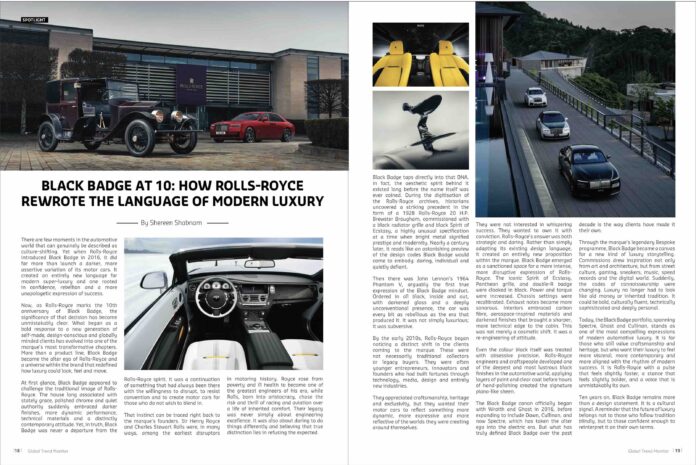

There are few moments in the automotive world that can genuinely be described as culture-shifting. Yet when Rolls-Royce introduced Black Badge in 2016, it did far more than launch a darker, more assertive variation of its motor cars. It created an entirely new language for modern super-luxury and one rooted in confidence, rebellion and a more unapologetic expression of success.
Now, as Rolls-Royce marks the 10th anniversary of Black Badge, the significance of that decision has become unmistakably clear. What began as a bold response to a new generation of self-made, design-conscious and globally minded clients has evolved into one of the marque’s most transformative chapters. More than a product line, Black Badge became the alter ego of Rolls-Royce and a universe within the brand that redefined how luxury could look, feel and move.
At first glance, Black Badge appeared to challenge the traditional image of Rolls-Royce. The house long associated with stately grace, polished chrome and quiet authority suddenly embraced darker finishes, more dynamic performance, technical materials and a distinctly contemporary attitude. Yet, in truth, Black Badge was never a departure from the Rolls-Royce spirit. It was a continuation of something that had always been there with the willingness to disrupt, to resist convention and to create motor cars for those who do not wish to blend in.
That instinct can be traced right back to the marque’s founders. Sir Henry Royce and Charles Stewart Rolls were, in many ways, among the earliest disruptors in motoring history. Royce rose from poverty and ill health to become one of the greatest engineers of his era, while Rolls, born into aristocracy, chose the risk and thrill of racing and aviation over a life of inherited comfort. Their legacy was never simply about engineering excellence. It was also about daring to do things differently and believing that true distinction lies in refusing the expected.
Black Badge taps directly into that DNA. In fact, the aesthetic spirit behind it existed long before the name itself was ever coined. During the digitisation of the Rolls-Royce archives, historians uncovered a striking precedent in the form of a 1928 Rolls-Royce 20 H.P. Brewster Brougham, commissioned with a black radiator grille and black Spirit of Ecstasy, a highly unusual specification at a time when bright metal signified prestige and modernity. Nearly a century later, it reads like an astonishing preview of the design codes Black Badge would come to embody: daring, individual and quietly defiant.
Then there was John Lennon’s 1964 Phantom V, arguably the first true expression of the Black Badge mindset. Ordered in all black, inside and out, with darkened glass and a deeply unconventional presence, the car was every bit as rebellious as the era that produced it. It was not simply luxurious; it was subversive.
By the early 2010s, Rolls-Royce began noticing a distinct shift in the clients coming to the marque. These were not necessarily traditional collectors or legacy buyers. They were often younger entrepreneurs, innovators and founders who had built fortunes through technology, media, design and entirely new industries. They appreciated craftsmanship, heritage and exclusivity, but they wanted their motor cars to reflect something more dynamic, more expressive and more reflective of the worlds they were creating around themselves.
They were not interested in whispering success. They wanted to own it with conviction. Rolls-Royce’s answer was both strategic and daring. Rather than simply adapting its existing design language, it created an entirely new proposition within the marque. Black Badge emerged as a sanctioned space for a more intense, more disruptive expression of Rolls-Royce. The iconic Spirit of Ecstasy, Pantheon grille, and double-R badge were cloaked in black. Power and torque were increased. Chassis settings were recalibrated. Exhaust notes became more sonorous. Interiors embraced carbon fibre, aerospace-inspired materials and darkened finishes that brought a sharper, more technical edge to the cabin. This was not merely a cosmetic shift. It was a re-engineering of attitude.
Even the colour black itself was treated with obsessive precision. Rolls-Royce engineers and craftspeople developed one of the deepest and most lustrous black finishes in the automotive world, applying layers of paint and clear coat before hours of hand-polishing created the signature piano-like sheen.
The Black Badge canon officially began with Wraith and Ghost in 2016, before expanding to include Dawn, Cullinan, and now Spectre, which has taken the alter ego into the electric era. But what has truly defined Black Badge over the past decade is the way clients have made it their own.
Through the marque’s legendary Bespoke programme, Black Badge became a canvas for a new kind of luxury storytelling. Commissions drew inspiration not only from art and architecture, but from street culture, gaming, sneakers, music, speed records and the digital world. Suddenly, the codes of connoisseurship were changing. Luxury no longer had to look like old money or inherited tradition. It could be bold, culturally fluent, technically sophisticated and deeply personal.
Today, the Black Badge portfolio, spanning Spectre, Ghost and Cullinan, stands as one of the most compelling expressions of modern automotive luxury. It is for those who still value craftsmanship and heritage, but who want their luxury to feel more visceral, more contemporary and more aligned with the rhythm of modern success. It is Rolls-Royce with a pulse that feels slightly faster, a stance that feels slightly bolder, and a voice that is unmistakably its own.
Ten years on, Black Badge remains more than a design statement. It is a cultural signal. A reminder that the future of luxury belongs not to those who follow tradition blindly, but to those confident enough to reinterpret it on their own terms.

