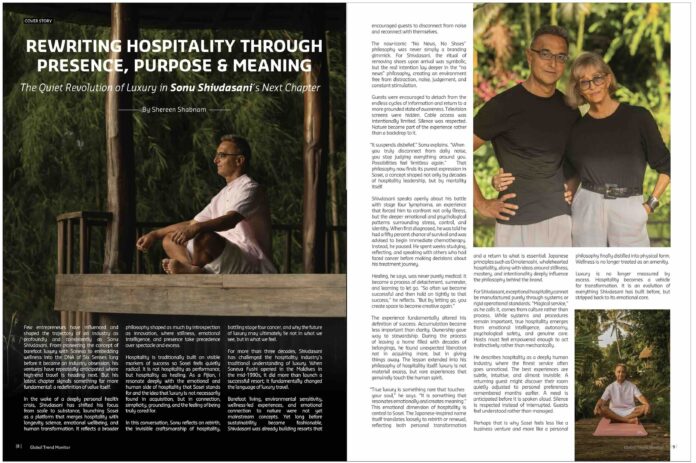

The Quiet Revolution of Luxury in Sonu Shivdasani’s Next Chapter
Few entrepreneurs have influenced and shaped the trajectory of an industry as profoundly and consistently as Sonu Shivdasani. From pioneering the concept of barefoot luxury with Soneva to embedding wellness into the DNA of Six Senses long before it became an industry obsession, his ventures have repeatedly anticipated where high-end travel is heading next. But his latest chapter signals something far more fundamental: a redefinition of value itself.
In the wake of a deeply personal health crisis, Shivdasani has shifted his focus from scale to substance, launching Sosei as a platform that merges hospitality with longevity science, emotional wellbeing, and human transformation. It reflects a broader philosophy shaped as much by introspection as innovation, where stillness, emotional intelligence, and presence take precedence over spectacle and excess.
Hospitality is traditionally built on visible markers of success so Sosei feels quietly radical. It is not hospitality as performance, but hospitality as healing. As a Fijian, I resonate deeply with the emotional and human side of hospitality that Sosei stands for and the idea that luxury is not necessarily found in acquisition, but in connection, simplicity, grounding, and the feeling of being truly cared for. In this conversation, Sonu reflects on rebirth, the invisible craftsmanship of hospitality, battling stage four cancer, and why the future of luxury may ultimately lie not in what we see, but in what we feel.
For more than three decades, Shivdasani has challenged the hospitality industry’s traditional understanding of luxury. When Soneva Fushi opened in the Maldives in the mid-1990s, it did more than launch a successful resort; it fundamentally changed the language of luxury travel. Barefoot living, environmental sensitivity, wellness-led experiences, and emotional connection to nature were not yet mainstream concepts. Yet long before sustainability became fashionable, Shivdasani was already building resorts that encouraged guests to disconnect from noise and reconnect with themselves.
The now-iconic “No News, No Shoes” philosophy was never simply a branding gimmick. For Shivdasani, the ritual of removing shoes upon arrival was symbolic, but the real intention lay deeper in the “no news” philosophy, creating an environment free from distraction, noise, judgement, and constant stimulation.
Guests were encouraged to detach from the endless cycles of information and return to a more grounded state of awareness. Television screens were hidden. Cable access was intentionally limited. Silence was respected. Nature became part of the experience rather than a backdrop to it.
“It suspends disbelief,” Sonu explains. “When you truly disconnect from daily noise, you stop judging everything around you. Possibilities feel limitless again.” That philosophy now finds its purest expression in Sosei, a concept shaped not only by decades of hospitality leadership, but by mortality itself.
Shivdasani speaks openly about his battle with stage four lymphoma, an experience that forced him to confront not only illness, but the deeper emotional and psychological patterns surrounding stress, control, and identity. When first diagnosed, he was told he had a fifty percent chance of survival and was advised to begin immediate chemotherapy. Instead, he paused. He spent weeks studying, reflecting, and speaking with others who had faced cancer before making decisions about his treatment journey.
Healing, he says, was never purely medical. It became a process of detachment, surrender, and learning to let go. “So often we become successful and then hold on tightly to that success,” he reflects. “But by letting go, you create space to become creative again.”
The experience fundamentally altered his definition of success. Accumulation became less important than clarity. Ownership gave way to stewardship. During the process of leaving a home filled with decades of belongings, he found unexpected liberation not in acquiring more, but in giving things away. The lesson extended into his philosophy of hospitality itself: luxury is not material excess, but rare experiences that genuinely touch the human spirit.
“True luxury is something rare that touches your soul,” he says. “It is something that resonates emotionally and creates meaning.” This emotional dimension of hospitality is central to Sosei. The Japanese-inspired name itself translates loosely to rebirth or renewal, reflecting both personal transformation and a return to what is essential. Japanese principles such as Omotenashi, wholehearted hospitality, along with ideas around stillness, mastery, and intentionality deeply influence the philosophy behind the brand.
For Shivdasani, exceptional hospitality cannot be manufactured purely through systems or rigid operational standards. “Magical service,” as he calls it, comes from culture rather than process. While systems and procedures remain important, true hospitality emerges from emotional intelligence, autonomy, psychological safety, and genuine care. Hosts must feel empowered enough to act instinctively rather than mechanically.
He describes hospitality as a deeply human industry where the finest service often goes unnoticed. The best experiences are subtle, intuitive, and almost invisible. A returning guest might discover their room quietly adjusted to personal preferences remembered months earlier. A need is anticipated before it is spoken aloud. Silence is respected instead of interrupted. Guests feel understood rather than managed.
Perhaps that is why Sosei feels less like a business venture and more like a personal philosophy finally distilled into physical form. Wellness is no longer treated as an amenity. Luxury is no longer measured by excess. Hospitality becomes a vehicle for transformation. It is an evolution of everything Shivdasani has built before, but stripped back to its emotional core.

