
How the world’s longest-lived communities are shaping the future of luxury development
Shereen Shabnam
More than two decades ago, a pioneering body of scientific research set out to answer a deceptively simple question: where do people live the longest and why? The findings revealed five extraordinary regions, later termed “blue zones,” where longevity is not only common, but accompanied by sustained health and quality of life.
The concept was first introduced by Dan Buettner, who led an expedition to Okinawa, Japan in 2000 to investigate its unusually high concentration of centenarians. What emerged was a compelling pattern: longevity in these regions was deeply rooted in lifestyle, environment, and daily habits, many of them shaped by close interaction with nature.
Buettner’s subsequent research identified four additional blue zones: Sardinia in Italy, the Nicoya Peninsula in Costa Rica, Icaria in Greece, and Loma Linda in California. Across these diverse geographies, common threads prevailed such as walkable communities, plant-based diets, strong social connections, and environments designed, intentionally or otherwise, to support wellbeing.
Today, this philosophy is extending far beyond academic study. It is influencing how cities, and more notably, how luxury communities are being conceived and built.
In Dubai, a city synonymous with innovation and ambition, the principles of blue zones are finding tangible expression. Talal M. Al Gaddah, CEO and Founder of the Keturah luxury brand, is among those translating this global insight into regional impact.
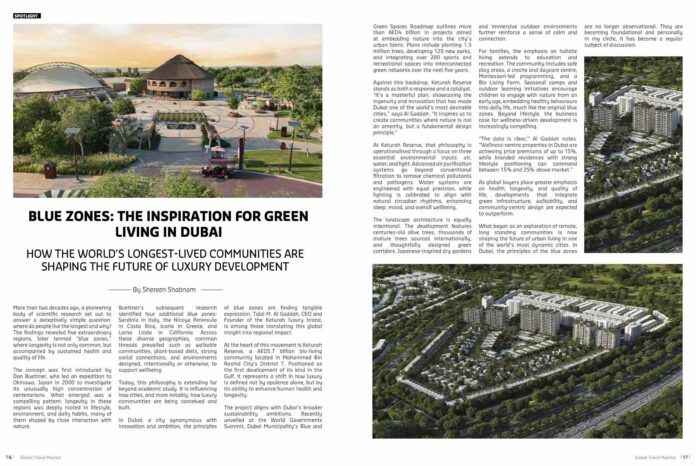
At the heart of this movement is Keturah Reserve, a AED5.7 billion bio-living community located in Mohammed Bin Rashid City’s District 7. Positioned as the first development of its kind in the Gulf, it represents a shift in how luxury is defined not by opulence alone, but by its ability to enhance human health and longevity.
The project aligns with Dubai’s broader sustainability ambitions. Recently unveiled at the World Governments Summit, Dubai Municipality’s Blue and Green Spaces Roadmap outlines more than AED4 billion in projects aimed at embedding nature into the city’s urban fabric. Plans include planting 1.5 million trees, developing 120 new parks, and integrating over 200 sports and recreational spaces into interconnected green networks over the next five years. Against this backdrop, Keturah Reserve stands as both a response and a catalyst.
“It’s a masterful plan, showcasing the ingenuity and innovation that has made Dubai one of the world’s most desirable cities,” says Al Gaddah. “It inspires us to create communities where nature is not an amenity, but a fundamental design principle.”
At Keturah Reserve, that philosophy is operationalised through a focus on three essential environmental inputs: air, water, and light. Advanced air purification systems go beyond conventional filtration to remove chemical pollutants and pathogens. Water systems are engineered with equal precision, while lighting is calibrated to align with natural circadian rhythms, enhancing sleep, mood, and overall wellbeing.
The landscape architecture is equally intentional. The development features centuries-old olive trees, thousands of mature trees sourced internationally, and thoughtfully designed green corridors. Japanese-inspired dry gardens and immersive outdoor environments further reinforce a sense of calm and connection.
For families, the emphasis on holistic living extends to education and recreation. The community includes safe play areas, a creche and daycare centre, Montessori-led programming, and a Bio Living Farm. Seasonal camps and outdoor learning initiatives encourage children to engage with nature from an early age, embedding healthy behaviours into daily life, much like the original blue zones. Beyond lifestyle, the business case for wellness-driven development is increasingly compelling.
“The data is clear,” Al Gaddah notes. “Wellness-centric properties in Dubai are achieving price premiums of up to 15%, while branded residences with strong lifestyle positioning can command between 15% and 25% above market.”
As global buyers place greater emphasis on health, longevity, and quality of life, developments that integrate green infrastructure, walkability, and community-centric design are expected to outperform.
What began as an exploration of remote, long standing communities is now shaping the future of urban living in one of the world’s most dynamic cities. In Dubai, the principles of the blue zones are no longer observational. They are becoming foundational and personally in my circle, it has become a regular subject of discussion.

