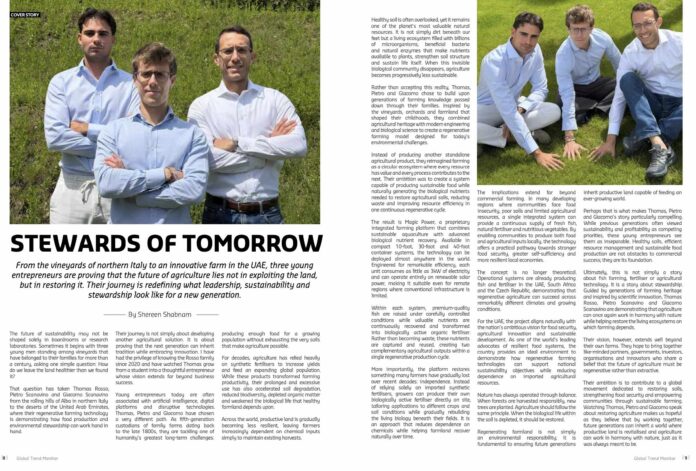

From the vineyards of northern Italy to an innovative farm in the UAE, three young entrepreneurs are proving that the future of agriculture lies not in exploiting the land, but in restoring it. Their journey is redefining what leadership, sustainability and stewardship look like for a new generation.
The future of sustainability may not be shaped solely in boardrooms or research laboratories. Sometimes it begins with three young men standing among vineyards that have belonged to their families for more than a century, asking one simple question: How do we leave the land healthier than we found it?
That question has taken Thomas Rosso, Pietro Scanavino and Giacomo Scanavino from the rolling hills of Alba in northern Italy to the deserts of the United Arab Emirates, where their regenerative farming technology is demonstrating how food production and environmental stewardship can work hand in hand.
Their journey is not simply about developing another agricultural solution. It is about proving that the next generation can inherit tradition while embracing innovation. I have had the privilege of knowing the Rosso family since 2020 and have watched Thomas grow from a student into a thoughtful entrepreneur whose vision extends far beyond business success.
Young entrepreneurs today are often associated with artificial intelligence, digital platforms and disruptive technologies. Thomas, Pietro and Giacomo have chosen a very different path. As fifth-generation custodians of family farms dating back to the late 1800s, they are tackling one of humanity’s greatest long-term challenges: producing enough food for a growing population without exhausting the very soils that make agriculture possible.
For decades, agriculture has relied heavily on synthetic fertilisers to increase yields and feed an expanding global population. While these products transformed farming productivity, their prolonged and excessive use has also accelerated soil degradation, reduced biodiversity, depleted organic matter and weakened the biological life that healthy farmland depends upon. Across the world, productive land is gradually becoming less resilient, leaving farmers increasingly dependent on chemical inputs simply to maintain existing harvests.
Healthy soil is often overlooked, yet it remains one of the planet’s most valuable natural resources. It is not simply dirt beneath our feet but a living ecosystem filled with billions of microorganisms, beneficial bacteria and natural enzymes that make nutrients available to plants, strengthen soil structure and sustain life itself. When this invisible biological community disappears, agriculture becomes progressively less sustainable.
Rather than accepting this reality, Thomas, Pietro and Giacomo chose to build upon generations of farming knowledge passed down through their families. Inspired by the vineyards, orchards and farmland that shaped their childhoods, they combined agricultural heritage with modern engineering and biological science to create a regenerative farming model designed for today’s environmental challenges.
Instead of producing another standalone agricultural product, they reimagined farming as a circular ecosystem where every resource has value and every process contributes to the next. Their ambition was to create a system capable of producing sustainable food while naturally generating the biological nutrients needed to restore agricultural soils, reducing waste and improving resource efficiency in one continuous regenerative cycle.
The result is Magic Power, a proprietary integrated farming platform that combines sustainable aquaculture with advanced biological nutrient recovery. Available in compact 10-foot, 30-foot and 40-foot container systems, the technology can be deployed almost anywhere in the world. Engineered for remarkable efficiency, each unit consumes as little as 3kW of electricity and can operate entirely on renewable solar power, making it suitable even for remote regions where conventional infrastructure is limited.
Within each system, premium-quality fish are raised under carefully controlled conditions while valuable nutrients are continuously recovered and transformed into biologically active organic fertiliser. Rather than becoming waste, these nutrients are captured and reused, creating two complementary agricultural outputs within a single regenerative production cycle.
More importantly, the platform restores something many farmers have gradually lost over recent decades: independence. Instead of relying solely on imported synthetic fertilisers, growers can produce their own biologically active fertiliser directly on site, tailoring applications to different crops and soil conditions while gradually rebuilding the living biology beneath their fields. It is an approach that reduces dependence on chemicals while helping farmland recover naturally over time.
The implications extend far beyond commercial farming. In many developing regions where communities face food insecurity, poor soils and limited agricultural resources, a single integrated system can provide a continuous supply of fresh fish, natural fertiliser and nutritious vegetables. By enabling communities to produce both food and agricultural inputs locally, the technology offers a practical pathway towards stronger food security, greater self-sufficiency and more resilient local economies.
The concept is no longer theoretical. Operational systems are already producing fish and fertiliser in the UAE, South Africa and the Czech Republic, demonstrating that regenerative agriculture can succeed across remarkably different climates and growing conditions.
For the UAE, the project aligns naturally with the nation’s ambitious vision for food security, agricultural innovation and sustainable development. As one of the world’s leading advocates of resilient food systems, the country provides an ideal environment to demonstrate how regenerative farming technologies can support national sustainability objectives while reducing dependence on imported agricultural resources.
Nature has always operated through balance. When forests are harvested responsibly, new trees are planted. Agriculture should follow the same principle. When the biological life within the soil is depleted, it should be restored. Regenerating farmland is not simply an environmental responsibility; it is fundamental to ensuring future generations inherit productive land capable of feeding an ever-growing world.
Perhaps that is what makes Thomas, Pietro and Giacomo’s story particularly compelling. While previous generations often viewed sustainability and profitability as competing priorities, these young entrepreneurs see them as inseparable. Healthy soils, efficient resource management and sustainable food production are not obstacles to commercial success; they are its foundation.
Ultimately, this is not simply a story about fish farming, fertiliser or agricultural technology. It is a story about stewardship. Guided by generations of farming heritage and inspired by scientific innovation, Thomas Rosso, Pietro Scanavino and Giacomo Scanavino are demonstrating that agriculture can once again work in harmony with nature while helping restore the living ecosystems on which farming depends.
Their vision, however, extends well beyond their own farms. They hope to bring together like-minded partners, governments, investors, organisations and innovators who share a belief that the future of agriculture must be regenerative rather than extractive. Their ambition is to contribute to a global movement dedicated to restoring soils, strengthening food security and empowering communities through sustainable farming. Watching Thomas, Pietro and Giacomo speak about restoring agriculture makes us hopeful as they believe that by working together, future generations can inherit a world where productive land is revitalised and agriculture can work in harmony with nature, just as it was always meant to be.

