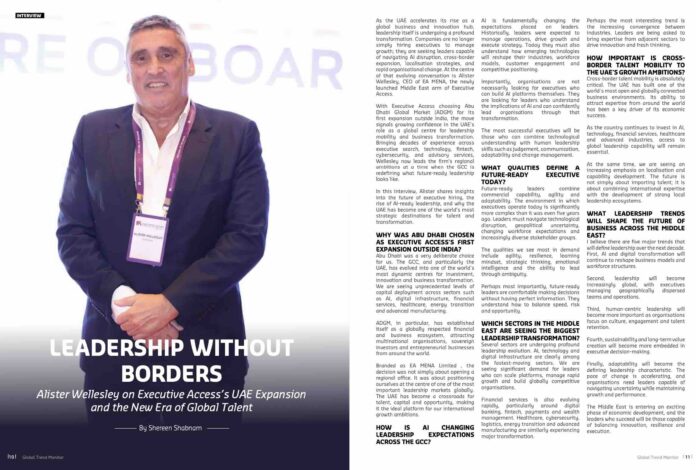

Leadership Without Borders
As the UAE accelerates its rise as a global business and innovation hub, leadership itself is undergoing a profound transformation. Companies are no longer simply hiring executives to manage growth; they are seeking leaders capable of navigating AI disruption, cross-border expansion, localisation strategies, and rapid organisational change. At the centre of that evolving conversation is Alister Wellesley, CEO of EA MENA, the newly launched Middle East arm of Executive Access.
With Executive Access choosing Abu Dhabi Global Market (ADGM) for its first expansion outside India, the move signals growing confidence in the UAE’s role as a global centre for leadership mobility and business transformation. Bringing decades of experience across executive search, technology, fintech, cybersecurity, and advisory services, Wellesley now leads the firm’s regional ambitions at a time when the GCC is redefining what future-ready leadership looks like.
In this interview, Alister shares insights into the future of executive hiring, the rise of AI-ready leadership, and why the UAE has become one of the world’s most strategic destinations for talent and transformation.
Why was Abu Dhabi chosen as Executive Access’s first expansion outside India?
Abu Dhabi was a very deliberate choice for us. The GCC, and particularly the UAE, has evolved into one of the world’s most dynamic centres for investment, innovation and business transformation. We are seeing unprecedented levels of capital deployment across sectors such as AI, digital infrastructure, financial services, healthcare, energy transition and advanced manufacturing.
ADGM, in particular, has established itself as a globally respected financial and business ecosystem, attracting multinational organisations, sovereign investors and entrepreneurial businesses from around the world.
Branded as EA MENA Limited , the decision was not simply about opening a regional office. It was about positioning ourselves at the centre of one of the most important leadership markets globally. The UAE has become a crossroads for talent, capital and opportunity, making it the ideal platform for our international growth ambitions.
How is AI changing leadership expectations across the GCC?
AI is fundamentally changing the expectations placed on leaders. Historically, leaders were expected to manage operations, drive growth and execute strategy. Today they must also understand how emerging technologies will reshape their industries, workforce models, customer engagement and competitive positioning.
Importantly, organisations are not necessarily looking for executives who can build AI platforms themselves. They are looking for leaders who understand the implications of AI and can confidently lead organisations through that transformation.
The most successful executives will be those who can combine technological understanding with human leadership skills such as judgement, communication, adaptability and change management.
What qualities define a future-ready executive today?
Future-ready leaders combine commercial capability, agility and adaptability. The environment in which executives operate today is significantly more complex than it was even five years ago. Leaders must navigate technological disruption, geopolitical uncertainty, changing workforce expectations and increasingly diverse stakeholder groups.
The qualities we see most in demand include agility, resilience, learning mindset, strategic thinking, emotional intelligence and the ability to lead through ambiguity.
Perhaps most importantly, future-ready leaders are comfortable making decisions without having perfect information. They understand how to balance speed, risk and opportunity.
Which sectors in the Middle East are seeing the biggest leadership transformation?
Several sectors are undergoing profound leadership evolution. AI, technology and digital infrastructure are clearly among the fastest-moving sectors. We are seeing significant demand for leaders who can scale platforms, manage rapid growth and build globally competitive organisations.
Financial services is also evolving rapidly, particularly around digital banking, fintech, payments and wealth management. Healthcare, cybersecurity, logistics, energy transition and advanced manufacturing are similarly experiencing major transformation.
Perhaps the most interesting trend is the increasing convergence between industries. Leaders are being asked to bring expertise from adjacent sectors to drive innovation and fresh thinking.
How important is cross-border talent mobility to the UAE’s growth ambitions?
Cross-border talent mobility is absolutely critical. The UAE has built one of the world’s most open and globally connected business environments. Its ability to attract expertise from around the world has been a key driver of its economic success.
As the country continues to invest in AI, technology, financial services, healthcare and advanced industries, access to global leadership capability will remain essential.
At the same time, we are seeing an increasing emphasis on localisation and capability development. The future is not simply about importing talent; it is about combining international expertise with the development of strong local leadership ecosystems.
What leadership trends will shape the future of business across the Middle East?
I believe there are five major trends that will define leadership over the next decade. First, AI and digital transformation will continue to reshape business models and workforce structures.
Second, leadership will become increasingly global, with executives managing geographically dispersed teams and operations.
Third, human-centric leadership will become more important as organisations focus on culture, engagement and talent retention.
Fourth, sustainability and long-term value creation will become more embedded in executive decision-making.
Finally, adaptability will become the defining leadership characteristic. The pace of change is accelerating, and organisations need leaders capable of navigating uncertainty while maintaining growth and performance.
The Middle East is entering an exciting phase of economic development, and the leaders who succeed will be those capable of balancing innovation, resilience and execution.

