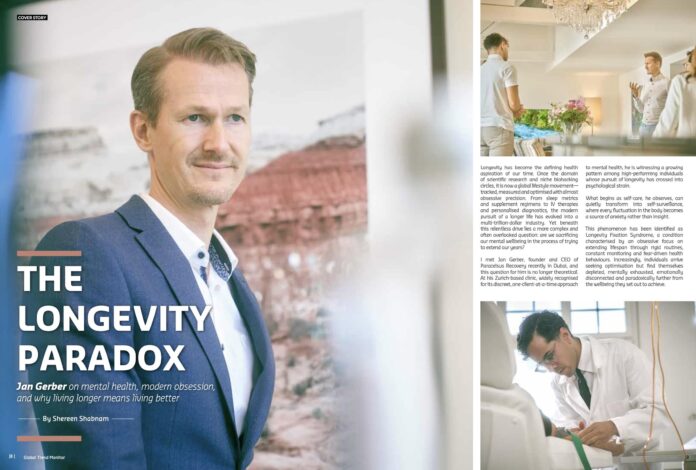

Jan Gerber on mental health, modern obsession, and why living longer means living better
Longevity has become the defining health aspiration of our time. Once the domain of scientific research and niche biohacking circles, it is now a global lifestyle movement – tracked, measured and optimised with almost obsessive precision. From sleep metrics and supplement regimens to IV therapies and personalised diagnostics, the modern pursuit of a longer life has evolved into a multi-trillion-dollar industry. Yet beneath this relentless drive lies a more complex and often overlooked question: are we sacrificing our mental wellbeing in the process of trying to extend our years?
I met Jan Gerber, founder and CEO of Paracelsus Recovery recently in Dubai, and this question for him is no longer theoretical. At his Zurich-based clinic, widely recognised for its discreet, one-client-at-a-time approach to mental health, he is witnessing a growing pattern among high-performing individuals whose pursuit of longevity has crossed into psychological strain. What begins as self-care, he observes, can quietly transform into self-surveillance, where every fluctuation in the body becomes a source of anxiety rather than insight.
This phenomenon has been identified as Longevity Fixation Syndrome, a condition characterised by an obsessive focus on extending lifespan through rigid routines, constant monitoring and fear-driven health behaviours. Increasingly, individuals arrive seeking optimisation but find themselves depleted, mentally exhausted, emotionally disconnected and paradoxically further from the wellbeing they set out to achieve.
At the heart of this paradox lies a fundamental misunderstanding of longevity itself. The modern narrative tends to prioritise control over diet, sleep, performance and even ageing. Yet, as Gerber points out, the very stress created by this hyper-control can undermine the body’s natural balance. Elevated cortisol levels, disrupted sleep and chronic inflammation are not side effects of poor health habits, but often the result of trying too hard to perfect them.
For Gerber, longevity cannot be separated from mental health. “There is no longevity without mental health,” he emphasises a statement that reframes the entire conversation. It shifts the focus from external optimisation to internal equilibrium, from performance metrics to emotional resilience.
This perspective is supported by decades of research. Long-term studies consistently show that the most significant predictor of longevity is not diet, exercise or even genetics, but the quality of human relationships. Individuals who maintain strong, supportive connections tend to live longer, healthier lives, not simply because of emotional comfort, but because connection itself regulates stress, improves physiological function and enhances overall wellbeing.
It is a reality that stands in stark contrast to today’s hyper-individualised wellness culture. While modern longevity practices often emphasise personal control, Gerber highlights that human beings are inherently social. Historically, survival and wellbeing were rooted in community, shared purpose and a sense of belonging. In many ways, the erosion of these structures has left a gap that no supplement or technology can fully replace.
At Paracelsus Recovery, this understanding shapes a deeply integrated approach to treatment. The clinic combines psychiatry and psychotherapy with what is now widely referred to as longevity or functional medicine, long before it became a global trend. Each programme is entirely tailored, examining not only mental health, but also the biological systems that influence it, from gut microbiome and hormonal balance to micronutrient deficiencies and inflammatory markers.
This convergence of disciplines reflects a broader shift in how health is understood. Rather than treating symptoms in isolation, the focus is on the individual as a whole. Advanced diagnostics, including genetic profiling and comprehensive laboratory testing, allow for highly personalised interventions designed to restore balance rather than impose rigid control.
Yet, despite the sophistication of these methods, Gerber remains clear that no treatment can replace the fundamentals of human connection. Many of the issues he encounters are not rooted in a lack of knowledge or access, but in deeper emotional challenges, loneliness, unresolved stress, or a loss of purpose.
This is particularly evident among high achievers, where success often comes at the expense of emotional balance. Anxiety, he explains, is the body’s natural response to uncertainty. But in an environment of constant stimulation, information overload and performance pressure, that response can become amplified, leading to chronic stress and burnout.
The challenge, then, is not to eliminate anxiety, but to understand it and to distinguish between healthy vigilance and spiralling control. The former allows for awareness and proactive care; the latter reduces life to a series of metrics, leaving little space for spontaneity, connection or joy.
As the global wellness industry continues its rapid expansion, the importance of this distinction becomes increasingly urgent. Longevity, once a fringe concept, is now embedded in mainstream culture. But as Gerber’s insights suggest, its true value lies not in the number of years we accumulate, but in the quality of those years.

