
An invitation to connoisseurs, patrons, and museums to steward one of the most consequential artifacts in the Islamic world
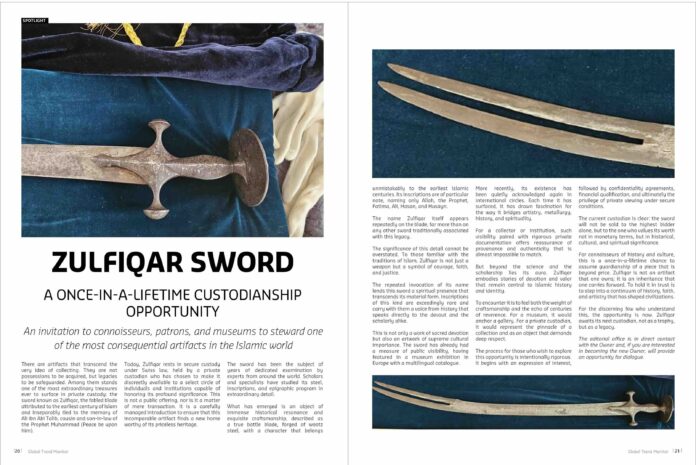
There are artifacts that transcend the very idea of collecting. They are not possessions to be acquired, but legacies to be safeguarded. Among them stands one of the most extraordinary treasures ever to surface in private custody: the sword known as Zulfiqar, the fabled blade attributed to the earliest century of Islam and inseparably tied to the memory of Ali ibn Abi Talib, cousin and son-in-law of the Prophet Muhammad (Peace be upon him).
Today, Zulfiqar rests in secure custody under Swiss law, held by a private custodian who has chosen to make it discreetly available to a select circle of individuals and institutions capable of honoring its profound significance. This is not a public offering, nor is it a matter of mere transaction. It is a carefully managed introduction to ensure that this incomparable artifact finds a new home worthy of its priceless heritage.
The sword has been the subject of years of dedicated examination by experts from around the world. Scholars and specialists have studied its steel, inscriptions, and epigraphic program in extraordinary detail.
What has emerged is an object of immense historical resonance and exquisite craftsmanship, described as a true battle blade, forged of wootz steel, with a character that belongs unmistakably to the earliest Islamic centuries. Its inscriptions are of particular note, naming only Allah, the Prophet, Fatima, Ali, Hasan, and Husayn. The name Zulfiqar itself appears repeatedly on the blade, far more than on any other sword traditionally associated with this legacy.
The significance of this detail cannot be overstated. To those familiar with the traditions of Islam, Zulfiqar is not just a weapon but a symbol of courage, faith, and justice. The repeated invocation of its name lends this sword a spiritual presence that transcends its material form. Inscriptions of this kind are exceedingly rare and carry with them a voice from history that speaks directly to the devout and the scholarly alike.
This is not only a work of sacred devotion but also an artwork of supreme cultural importance. The sword has already had a measure of public visibility, having featured in a museum exhibition in Europe with a multilingual catalogue.
More recently, its existence has been quietly acknowledged again in international circles. Each time it has surfaced, it has drawn fascination for the way it bridges artistry, metallurgy, history, and spirituality. For a collector or institution, such visibility paired with rigorous private documentation offers reassurance of provenance and authenticity that is almost impossible to match.
But beyond the science and the scholarship lies its aura. Zulfiqar embodies stories of devotion and valor that remain central to Islamic history and identity. To encounter it is to feel both the weight of craftsmanship and the echo of centuries of reverence. For a museum, it would anchor a gallery. For a private custodian, it would represent the pinnacle of a collection and as an object that demands deep respect.
The process for those who wish to explore this opportunity is intentionally rigorous. It begins with an expression of interest, followed by confidentiality agreements, financial qualification, and ultimately the privilege of private viewing under secure conditions. The current custodian is clear: the sword will not be sold to the highest bidder alone, but to the one who values its worth not in monetary terms, but in historical, cultural, and spiritual significance.
For connoisseurs of history and culture, this is a once-in-a-lifetime chance to assume guardianship of a piece that is beyond price. Zulfiqar is not an artifact that one owns; it is an inheritance that one carries forward. To hold it in trust is to step into a continuum of history, faith, and artistry that has shaped civilizations.
For the discerning few who understand this, the opportunity is now. Zulfiqar awaits its next custodian, not as a trophy, but as a legacy.
The editorial office is in direct contact with the Owner and, if you are interested in becoming the new Owner, will provide an opportunity for dialogue.


Wau…! Is it possible..?!
This is a GREAT news for Islam!
Why this Sacred Sword of Prophet Muhammad (God bless Him) is not yet in Medina?!
What is the price – ?
If it’s real Sword Zulfiqar the money is not a problem!
An absolutely fascinating read! The Zulfiqar Sword represents not only a priceless artifact of Islamic history but also a profound symbol of courage, faith, and legacy. It’s inspiring to see such a sacred relic being preserved with the respect and responsibility it truly deserves.
What a fascinating and deeply moving piece! The way the article highlights the extraordinary legacy of the sword, its provenance, and its significance to both cultural history and spiritual heritage, is truly compelling. It’s rare to find an artifact whose story intertwines craftsmanship, devotion, and identity as vividly as this one. Kudos to the author and Global Trend Monitor for bringing such a profound “once-in-a-lifetime stewardship opportunity” into the spotlight. I felt inspired by the idea of custodianship rather than ownership — treating the sword as an inheritance to honour rather than a trophy to acquire — and I hope many institutions and individuals will rise to the call. Thank you for this remarkable read.
In my opinion, the most worthy guardian of this sword of all time could be His Highness Sheikh Al Maktoum.
What a remarkable opportunity — the rediscovery and custodianship of Zulfiqar is nothing short of historic. Wherever this legendary blade finds its new home, I believe it will become a new cultural and spiritual “mecca” — a place where generations can come together to honor faith, heritage, and the profound legacy this sword represents. The thoughtfulness behind ensuring it goes to someone who deeply respects its meaning — rather than just the highest bidder — speaks volumes. Thank you for reminding us that some treasures aren’t possessions, but legacies meant to be preserved and revered.
Long live Zulfiqar! Sword of ISLAM!
JUSTICE and PEACE!
The Country to which this will Go will become a second Mecca for us pilgrims.
Such a relic should, of course, be kept by a truly devout person and should also be accessible to ordinary people. I believe that this sword should be displayed in museums so that devout people can see it. And I think that the sellers chose the right criterion for the buyer — he must be a devout person not in words but in deeds.