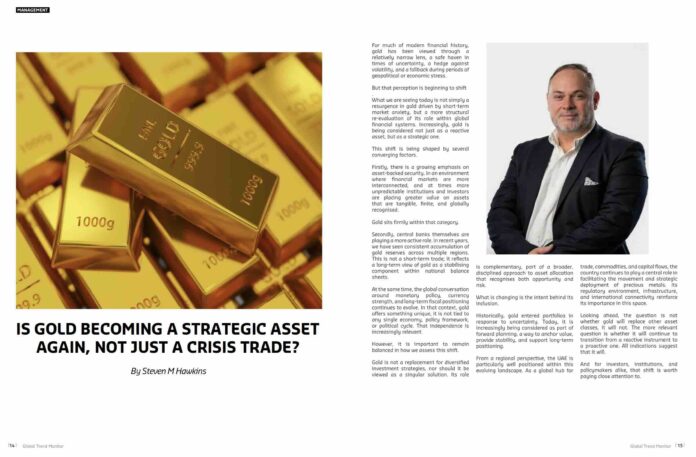

For much of modern financial history, gold has been viewed through a relatively narrow lens, a safe haven in times of uncertainty, a hedge against volatility, and a fallback during periods of geopolitical or economic stress.
But that perception is beginning to shift.
What we are seeing today is not simply a resurgence in gold driven by short-term market anxiety, but a more structural re-evaluation of its role within global financial systems. Increasingly, gold is being considered not just as a reactive asset, but as a strategic one.
This shift is being shaped by several converging factors.
Firstly, there is a growing emphasis on asset-backed security. In an environment where financial markets are more interconnected, and at times more unpredictable institutions and investors are placing greater value on assets that are tangible, finite, and globally recognised. Gold sits firmly within that category.
Secondly, central banks themselves are playing a more active role. In recent years, we have seen consistent accumulation of gold reserves across multiple regions. This is not a short-term trade; it reflects a long-term view of gold as a stabilising component within national balance sheets.
At the same time, the global conversation around monetary policy, currency strength, and long-term fiscal positioning continues to evolve. In that context, gold offers something unique, it is not tied to any single economy, policy framework, or political cycle. That independence is increasingly relevant.
However, it is important to remain balanced in how we assess this shift.
Gold is not a replacement for diversified investment strategies, nor should it be viewed as a singular solution. Its role is complementary, part of a broader, disciplined approach to asset allocation that recognises both opportunity and risk.
What is changing is the intent behind its inclusion.
Historically, gold entered portfolios in response to uncertainty. Today, it is increasingly being considered as part of forward planning, a way to anchor value, provide stability, and support long-term positioning.
From a regional perspective, the UAE is particularly well positioned within this evolving landscape. As a global hub for trade, commodities, and capital flows, the country continues to play a central role in facilitating the movement and strategic deployment of precious metals. Its regulatory environment, infrastructure, and international connectivity reinforce its importance in this space.
Looking ahead, the question is not whether gold will replace other asset classes, it will not. The more relevant question is whether it will continue to transition from a reactive instrument to a proactive one. All indications suggest that it will.
And for investors, institutions, and policymakers alike, that shift is worth paying close attention to.

