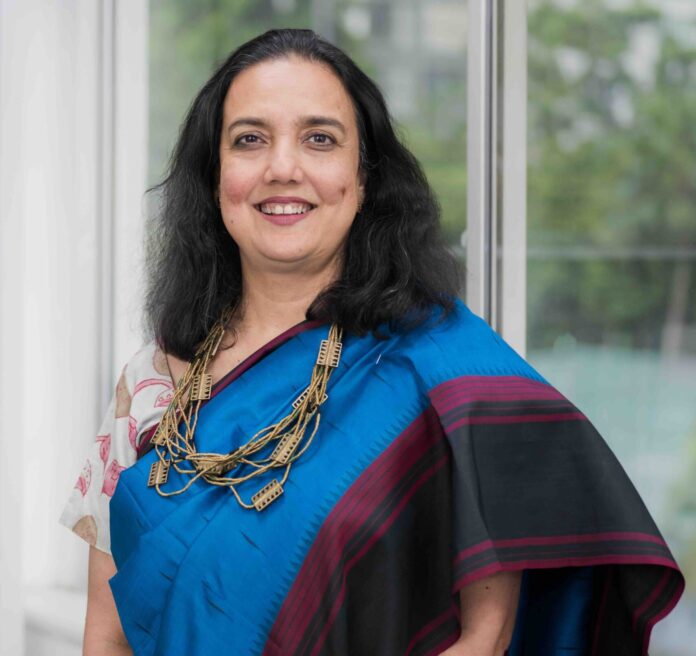

Naina Subberwal Batra, CEO of AVPN on Scaling Social Investment Across Asia
Shereen Shabnam
At a time when the world is questioning not only how wealth is created, but where it flows and what it ultimately changes, Naina Subberwal Batra is helping redefine the answer for Asia. As the Chief Executive Officer of AVPN, the region’s largest network of social investors, she has become one of the most influential figures shaping the future of philanthropy, private investment, corporate responsibility and institutional funding to drive meaningful, measurable change.
Over the past decade, she has helped shift the region’s mindset from fragmented giving to strategic, systems-led investment. With climate urgency, widening inequality and a historic transfer of wealth around, her work sits at the intersection of leadership, capital and accountability. Naina also serves as a Board Director of the Blue Earth Foundation and sits on the boards of the Menzies Foundation and Blue Planet Environmental Solution Pte Ltd.
Her leadership has earned international recognition, including being named to the Devex Power 50 in 2026 for transforming global development, inclusion in Tatler Asia’s Most Influential list 2025, and recognition by CSRWorks as one of Asia’s Top Sustainability Superwomen and she is a fellow of The Bellagio Center Residency Programme, shaping conversations around sustainable finance, systems change and cross-sector collaboration.
Recognised globally for her role in transforming development and sustainability conversations, Naina speaks to Global Trend Monitor about the evolution of social investing, the leadership required to scale impact, and why the next generation of capital allocators must think far beyond returns.
Since becoming CEO in 2013, how have you seen the definition of “social investment” evolve across Asia?
When I began in 2013, venture philanthropy was largely a Western construct. In much of Asia, the two words did not naturally sit together. Venture was associated with business and financial returns. Philanthropy was associated with charity. Combining the two required some explanation.
That early experience made it clear that terminology was not the priority. What mattered was mobilising capital in ways that resonated locally and reflected how wealth is deployed across Asia.
Over the past decade, the definition has broadened significantly. Social investment now spans philanthropic capital, corporate CSR, private markets, family offices and institutional investors. The focus has shifted from debating labels to aligning larger pools of capital with measurable outcomes.
The deeper evolution has been one of ambition and ownership. From South Asia to the Gulf, we are no longer adapting imported models of impact. We are designing our own. Social investment in Asia has moved from proof of concept to proof of scale.
AVPN has expanded from a venture philanthropy focus to a broader ecosystem platform. What drove that strategic shift?
We realised early on that no single form of capital would be enough. Asia’s challenges are interconnected, and so are the solutions.
What we kept seeing were philanthropists, impact investors, corporates and governments working on the same issues, but often in parallel. The real opportunity was to bring them into one ecosystem where capital, knowledge and networks could align and work together. That shaped our evolution. We are not a funder and we do not implement programmes. Our role is to enable others to connect, collaborate and mobilise capital more effectively.
Today, with more than 700 members across 43 markets and over USD 520 billion raised by the network, it is clear that there is a strong demand for this kind of platform. The shift was less about expansion and more about responding to what the region needed.
In practical terms, what does it take to unlock greater financial and intellectual capital for impact in emerging markets?
It comes down to three things: credibility, connections and capacity. Funders need confidence that the opportunities presented are well-governed and investment-ready. That requires rigorous due diligence and a curated pipeline. At AVPN, our ImpactCollab platform maintains over 400 investable opportunities for that reason.
Capital also follows trust. Relationships matter. Convening the right people in the same room still makes a difference.
Finally, organisations need the capacity to absorb capital effectively. Governance, financial management and impact reporting are not secondary considerations. They are foundational. The scale of the challenge is significant. Asia requires around USD 1.5 trillion annually to meet the Sustainable Development Goals by 2030. Traditional approaches alone will not close that gap. Family offices, private markets and sovereign capital all have a role to play. Capital is not scarce in Asia. Confidence, coordination and discipline are.
How can corporate CSR leaders and impact investors better collaborate to create systemic, long-term change?
The first step is to stop operating in silos. We see stronger results when corporates move beyond treating social impact as a standalone CSR budget and begin aligning core business decisions with the same objectives. Procurement, hiring, supply chains and investment strategies should reinforce the impact goals they are funding.
When that alignment happens, conversations with impact investors become more substantive. You are solving the same problem from different angles, rather than simply co-branding a project.
In West Asia in particular, there is a clear appetite for multi-sector collaboration. When the private sector, public institutions and communities work towards shared outcomes, the results tend to be more durable. Long-term change requires that level of coordination.
What are the biggest barriers preventing capital from reaching high-potential social enterprises in Asia?
The barriers are rarely about intent. They are about structure. First, many investors struggle to identify credible, investment-ready organisations. Local context and due diligence matter, and not every funder has access to that insight.
Second, some of the sectors with the greatest need, including health, climate and gender inclusion, do not always fit traditional commercial models. Conventional investment criteria can exclude the very organisations tackling the hardest problems. Blended finance can help bridge that gap by sharing risk more thoughtfully.
Third, even when capital is available, not every organisation is prepared to absorb it effectively. Governance, financial management and impact reporting are essential foundations. Across Asia including West Asia, capital is not the constraint. Coordination, trust and deployable pipelines are.
As a leader recognised globally for your influence in sustainability, how do you balance growth with maintaining mission integrity?
Growth is only meaningful if it strengthens the mission. In sustainability, there is always pressure to scale quickly. But scale without clarity can dilute impact. For me, integrity begins with being explicit about what we exist. When the purpose is clear, decisions about partnerships, expansion and programmes become easier because they are tested against that purpose. It also requires discipline. Not every opportunity is the right one. Staying mission-aligned sometimes means saying no.
Finally, transparency matters. In a sector built on trust, you have to be honest about outcomes, progress and gaps. Growth should deepen credibility, not replace it. Institutions that endure are those that expand with intention, not urgency.
From your board roles across environmental and philanthropic organisations, what trends are shaping the future of sustainable development?
One clear trend is convergence. Climate, health and gender are increasingly inseparable. Climate change affects maternal health and livelihoods and it deepens inequality. Addressing these issues in isolation limits impact. The most effective capital today is flowing toward solutions that recognise and address these intersections.
A second shift is the more strategic deployment of philanthropic capital. Rather than acting solely as a grant-maker of last resort, philanthropy is being used to de-risk innovation, crowd in private capital and unlock markets that would otherwise remain underfunded.
We are also seeing a stronger emphasis on measurable outcomes. Investors, regulators and communities are asking harder questions about what has actually changed. That is a healthy evolution.
Finally, leadership is becoming more regional and locally grounded. Across Asia and West Asia, there is growing confidence in home-grown capital and institutions shaping their own development agendas. That shift will define the next decade.
Sustainable development is moving from the margins to the centre of economic decision-making. The question now is not whether it matters, but how seriously we are prepared to act on it.
Looking ahead, what should Asia’s next generation of social investors prioritise to remain relevant in a rapidly shifting global economy?
The challenges Asia faces do not sit neatly within sectors, and the investors who will remain relevant are those who can think across boundaries and commit for the long term. Short-term deployment is not enough. Climate risk, demographic shifts and inequality require patient capital and systems thinking. The next generation must be comfortable working across public and private markets, across philanthropy and investment, and across borders.
They should also recognise the scale of the generational wealth transfer underway. In the GCC alone, nearly USD 2 trillion is expected to pass to the next generation over the coming decade. Across Asia, similar transitions are reshaping capital markets. Many of these inheritors are more globally connected and more values-driven. The generational wealth transfer in West Asia and across Asia is historic. The real question is whether we have built the infrastructure to deploy it with discipline and measurable impact.
Asia requires approximately USD 1.5 trillion annually to meet the Sustainable Development Goals by 2030. That figure alone should shift the conversation from incremental efforts to systemic strategies.
In the next decade, credibility will be measured not by capital committed, but by outcomes delivered.

